The Magick Was Never the Add-On
The wu, the spirit-medium, is in the oracle bones before the book-trained doctor. Sun Simiao wrote spells and talismans into his own formulary. The magick was never the add-on; the clean split came late.
The wu, the spirit-medium, is in the oracle bones before the book-trained doctor. Sun Simiao wrote spells and talismans into his own formulary. The magick was never the add-on; the clean split came late.
From The Magick That Never Left: Classical Chinese Medicine and the Tradition Still Beneath It
This is chapter two of a serialized book. ← Chapter 1: Chinese Medicine Is 75 Years Old · Chapter 3 is next; there's a subscribe link at the bottom.
~10 minute read
A quick note before we start: this is a personal essay on the history of Chinese medicine and my own spiritual practice, not medical advice. "Magick" with the k means the old craft, not stage tricks, and anyone described here is a composite. The full version of this note is at the foot of the page.

Sun Simiao (Sūn Sīmiǎo) is the closest thing Chinese medicine has to a patron saint: 藥王 (yàowáng), the King of Medicine, later deified, still on the syllabus 13 centuries on. Open the formulary that made him canonical and you find a herb prescription dozens of ingredients deep and, in the same book, the incantation to chant over the person who takes it. Same hand. No wall between them. That is not a folk healer at the margins. That is the dead center of the tradition, declining to draw the line the rest of us now treat as obvious and ancient.
So here is the thesis, and it runs against the romance. I'm not saying medicine and magick were ever an undivided blur; the people who did both could tell a spell from a drug, and sometimes said so. I'm saying the spirit-work was load-bearing and there from the start, and the clean split that cut it out came late. The magick was never the add-on. The split was. The reader I'm writing for is the one trained where I trained, handed a Chinese medicine scrubbed of its spirits and told the clean version is the original. That picture is backwards.
You can start to see it in one word, the word for the thing I do. But the word only points. The proof is in the ground.
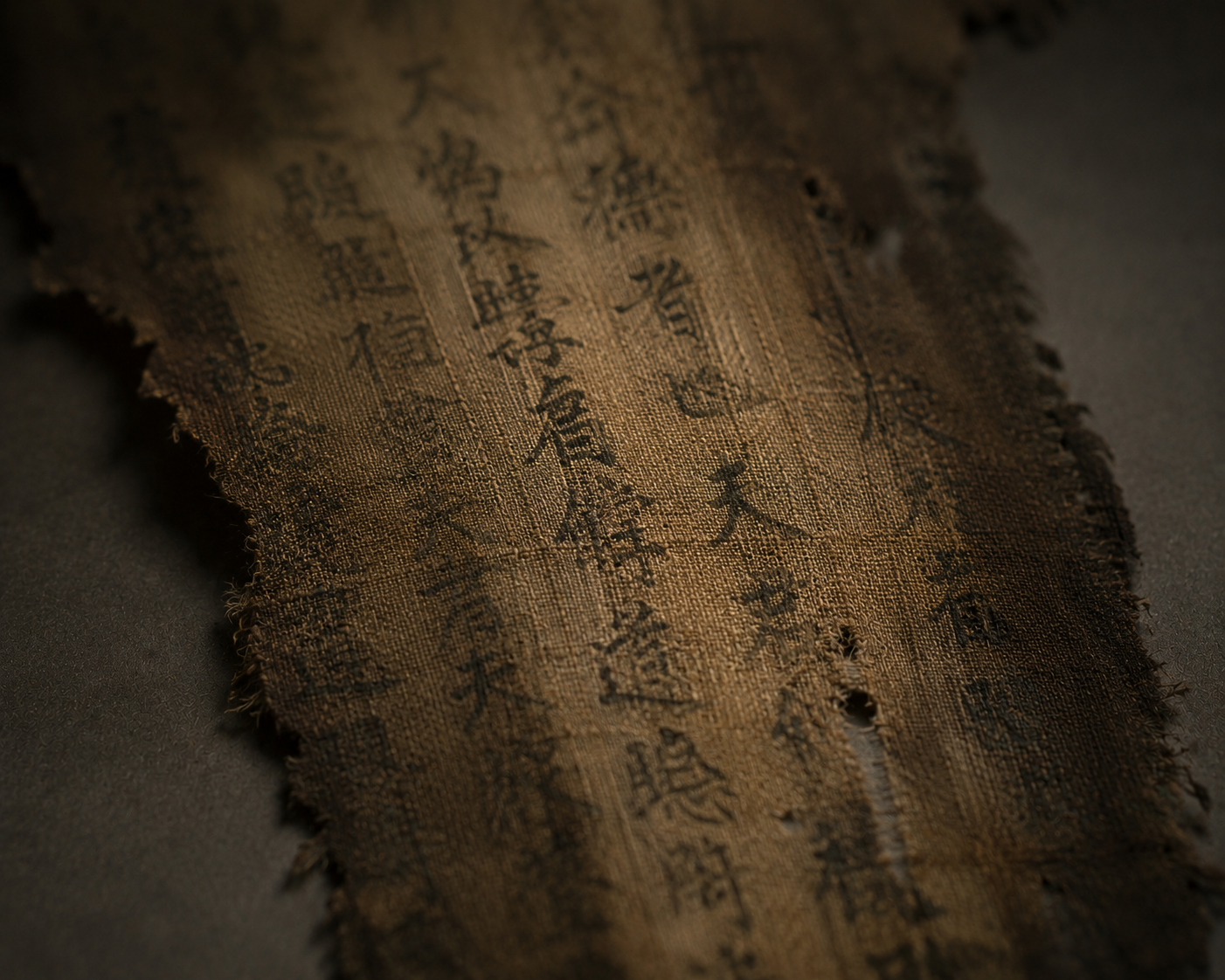
Start with what we can actually hold. In 1973, diggers opened a tomb sealed in 168 BCE and found the earliest medical manuscripts we've recovered. In the main one, the cures for a single illness sit side by side: a herbal remedy, and a spell to say over it, same ailment, same page. About 40 of the recipes are flat-out incantation and ritual, shelved right in among the drugs. And the era could tell spell-folk from drug-folk when it wanted to, so this isn't ignorance. The distinction was available. Nobody bothered to enforce it. Donald Harper, who translated these manuscripts, calls the early picture a craft dominated by magico-religious belief and practice that only slowly turned into theory. The mix isn't a corruption that crept into a pure medicine later. It's in the oldest evidence we have, and we dug it up.
And these aren't vague blessings tucked in a margin. Some of the recipes tell you to address the ailment directly, by name, like a thing that can hear you, spit at it, and say the words while you do it. One of the scorpion-sting recipes, in Harper's translation, opens "Spit on it and spout," and then gives you the words: "Father dwells in Shu. Mother is the Wind Bird who punishes. Do not dare flee up or down. The Wind Bird bores your heart." That's from the scorpion recipes in his translation of the Fifty-Two Ailments, sitting in the same matter-of-fact register as the drug doses beside them. An incantation, with a dosage schedule for company.
The spirit-worker was no folklore figure at the edge of medicine. He was there first. 巫 (wū), the spirit-medium, turns up in the oracle bones, the oldest Chinese writing there is, older in the record than the book-trained physician. There's no tidy English word for what a wū did, because he did all of it at once: medium, healer, exorcist, reader of signs. And for a long stretch he was a recognized kind of doctor with his own name, the compound 巫醫 (wū yī), "shaman" and "physician" welded into one word.
You don't weld two words into one job title for things nobody ever thought belonged together.
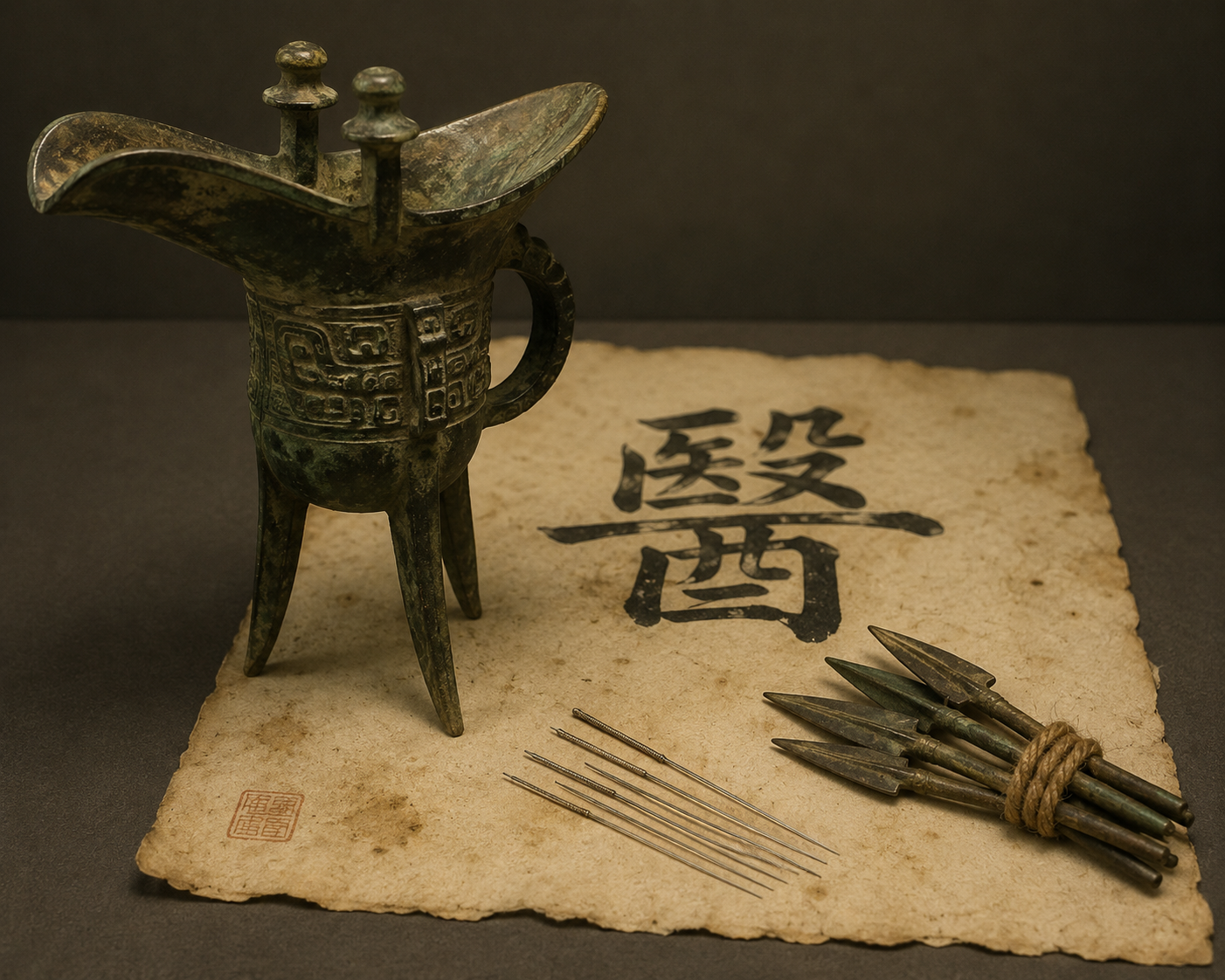
Now the word for the thing I do, because people keep reading too much into it. Pull apart the standard character, 醫 (yī): a quiver of arrows and a hand gripping a weapon on top, and 酉 (yǒu), a wine vessel, at the base. A cutter and a druggist, surgery and pharmacy baked into the glyph, though the stricter philology reads that whole top half as the word’s sound, not a picture of its work. There is no shaman in it, and I want to be exact about that, because the romantic version cheats right here. But there is an old, attested way of writing the same word, the variant 毉: same arrows and hand on top, and at the base, where the wine jar sat, 巫, the shaman. In that form the wū is the floor the character stands on, the radical at its root. The tradition wrote the word both ways. That is the honest fact, and it is not proof that the shaman came first. The best etymology, from Schuessler (Axel Schuessler), traces the word back to "potion," the wine jar. The graph only ever pointed. The proof was never in the brushwork. It was in the ground, in 巫醫, and, later, on the exam.
Now the English words, because they have been quietly doing something. "Acupuncturist." "Herbalist." Two trades, two people, or so the words imply. But the Chinese for the first is 針灸 (zhēn jiǔ), two characters: 針, the needle, and 灸, moxa, the burning of mugwort, the fire half of the craft. The trade is the needle and the fire both. English kept the needle and dropped the fire, not for lack of a word, since "moxibustion" is right there in the dictionary, but because the field named itself, in English, after half its own toolkit. "Herbalist" is thinner still. The Chinese category, 本草 (běn cǎo), was never just plants. It is minerals, animal parts, substances prepared closer to alchemy than gardening. And the person who handled all of it was the same person who held the needle. He was 醫, the doctor.
So state the loss precisely, because the easy version is wrong. English didn't invent the division of labour. Chinese medicine had specialists for centuries, and needle-work and herb-work were genuinely distinct callings. The narrower charge is the true one. The old word 醫 covered a physician who needled and burned and dosed and read pulses and, when it came to it, dealt with the spirits and the dead. The English titles keep the first jobs and quietly drop the last. The loss isn't the splitting. The loss is the piece that made it into neither box.
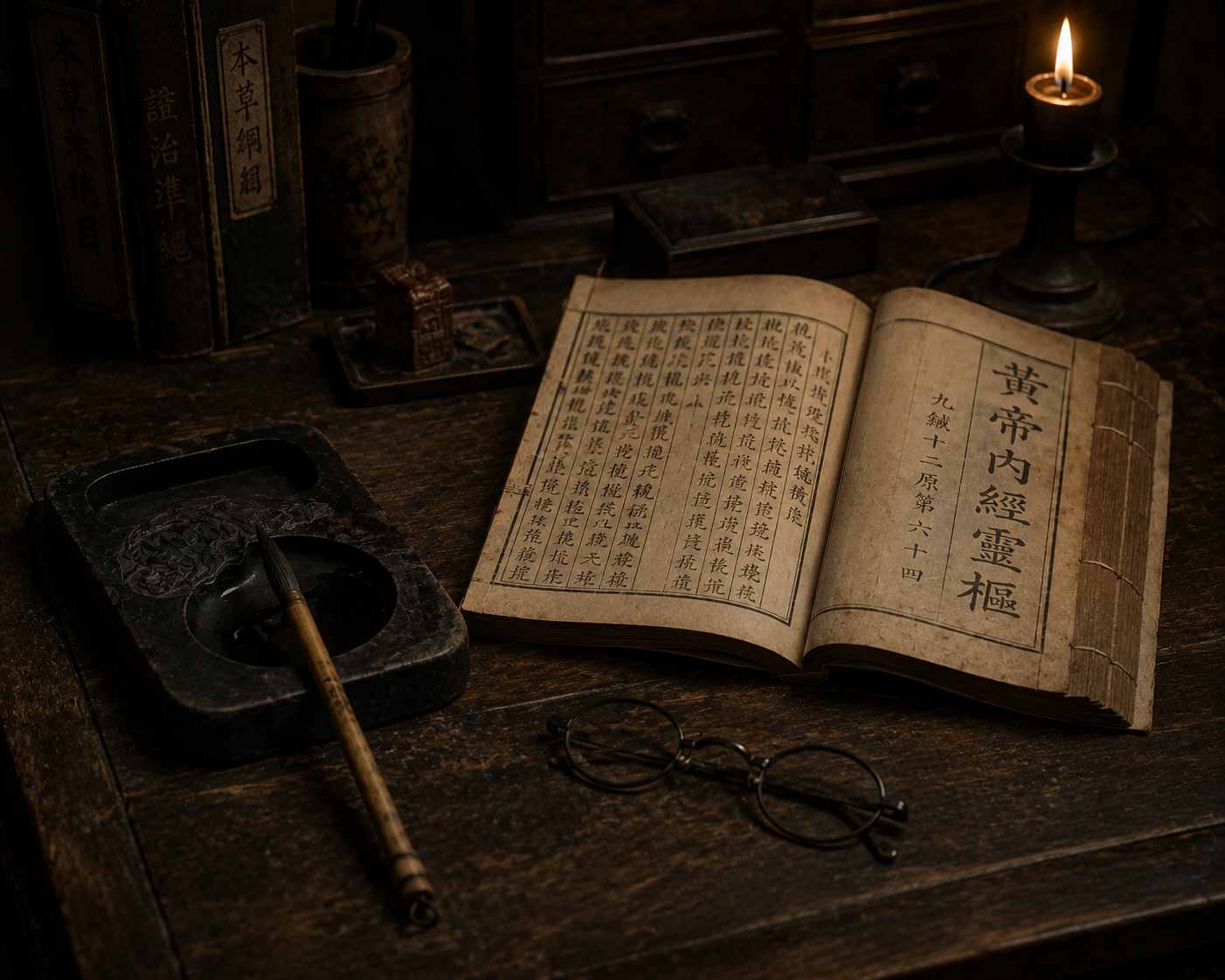
And the splitting wasn't a Western sin done to a Chinese whole. The Chinese did it themselves, by law. The Yuan medical examinations were built on 13 official subjects: internal medicine, pediatrics, eye medicine, bone-setting, acupuncture, the ones you'd expect, and one more, with its own name and its own section, 祝由 (zhùyóu), "charms and spells." Ritual healing wasn't whispered about at the back door. It was a tested specialty of the state academy, beside acupuncture, and the scholars closest to it, like Cho (Philip Cho), read it as serious, current medicine. The magick was on the exam. The clean cut that finally put it outside medicine came much later, and the English titles only did a cruder version of that later cut.
So when somebody asks why an acupuncturist is talking about ancestors and spirits, the honest answer is that "acupuncturist" is a translation casualty, a shrunk English box around a role that was never that small. The needle doesn't do the magick. The word for it once held both.
If you think the magick is a fringe thing the tradition is embarrassed about, stay with Sun Simiao, because he is the center, not the margin. Tang dynasty, died 682, later deified as 藥王. He wrote the two formularies the prescription tradition rests on, the 備急千金要方 (Bèijí Qiānjīn Yàofāng) and its sequel the 千金翼方 (Qiānjīn Yìfāng): thousands of formulas, pulse diagnosis, acupuncture, moxa. Foundational clinical literature, not folklore.
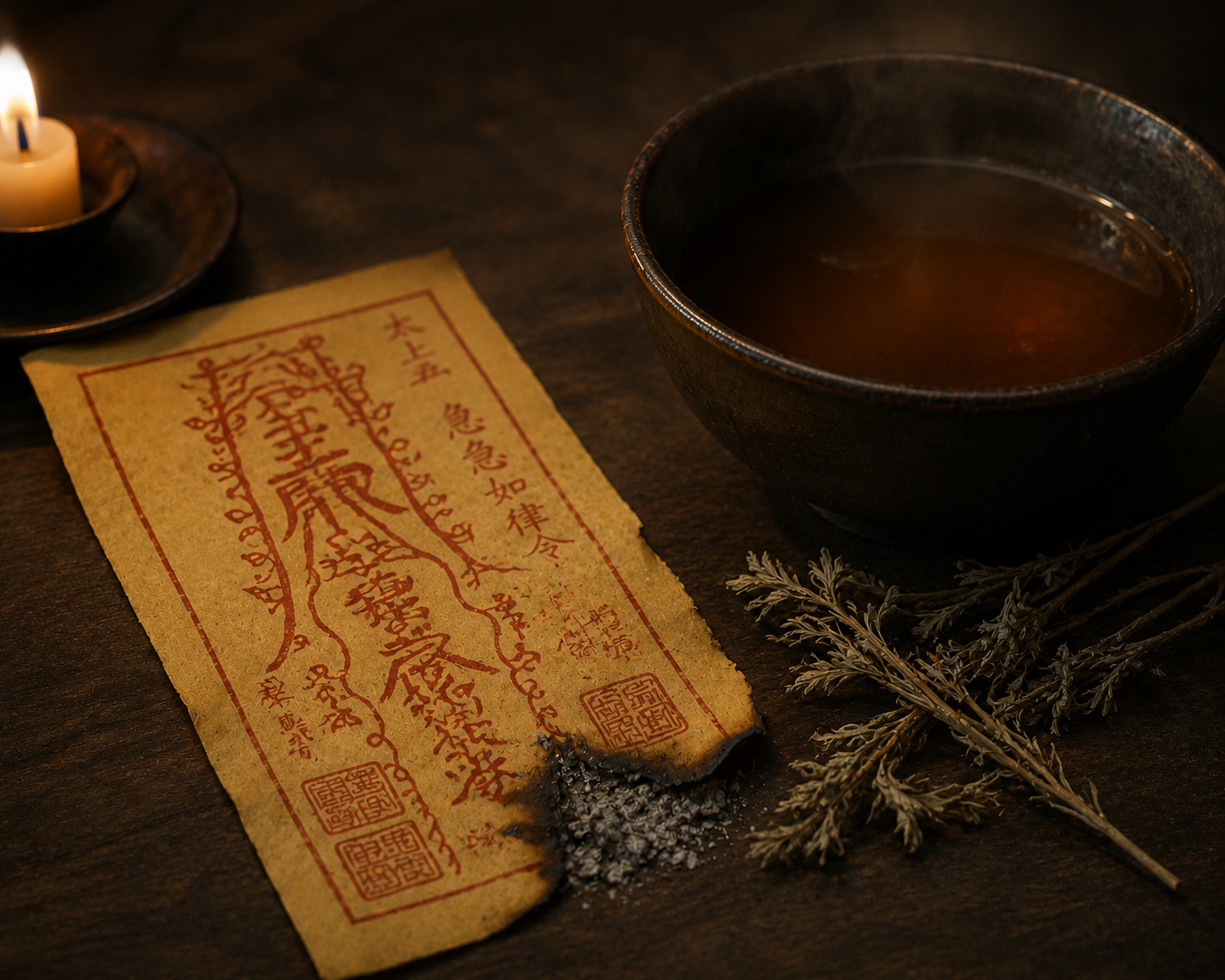
The sequel also carries what scholars call his Book of Spellbinding, the 禁經 (jìnjīng): talismans, incantations, exorcisms, acupuncture points listed specifically for driving out demons. Michel Strickmann, who studied this material most closely, thinks Sun must have trained as a Daoist priest, because only an initiate would have known the rites. And Sun didn't code any of it. No occult appendix in different binding, no private grimoire for initiates. He set the talisman beside the decoction because, to him, they were one project: treat the person in front of you with whatever the case calls for.
The honest objection isn't that Sun couldn't have drawn the line. By the time the Yellow Emperor's classic was compiled, elite medicine was already drawing it, and drawing it against the wu. One Suwen (Sùwèn) passage runs, in effect, that with someone "bound up with ghosts and spirits" you cannot even begin to talk real medicine. A skeptic reads that and says: there's your proof, the serious tradition had already cut the spirit-work loose. That reading has teeth. The classics drew the line early.
Here is why it still doesn't carry. The line got drawn, and the people at the center stepped over it on purpose. Sun read the Suwen and put the spells in his own formulary anyway. Centuries later the Yuan academy read the same misgivings and still listed 祝由 among its 13 subjects, beside acupuncture, on the examined roster. Keep two claims apart, because the title folds them together. This chapter defends the first: the spirit-work was load-bearing and there from the start. The other half: pulling it cleanly out was a late act, not an early one. "Never the add-on" is the first claim. It denies the spirit-work was ever bolted on, not the slow centuries of prying that came before the clean cut. And the clean cut, when it finally came, was not ancient and not gradual. It has a date and a paper trail: the mid-twentieth-century remaking of this medicine into a secular, standardized profession, the reform that took the talismans and the demon-points out of the textbooks and called what was left the whole of it. That is the split, and it is recent. The full account is chapter 1's story; here it is enough to see that the thing we inherited as "the original" is the youngest part of all.
And it wasn't one man's quirk. Sun opens his whole work not with technique but with the doctor's character: a still heart, real compassion, the same care for the rich man, the poor man, and even the enemy. The instrument comes before the formula. He says that first, before a single prescription.
Fine, you might say. The etymology is a hook, the exam is a good fact, Sun is a party trick, but it is all centuries dead. Does any of it change anything once a living person is in the room? Yes. Watch one appointment run two ways.
A man comes in for insomnia. The narrow practitioner takes the complaint at its word: points for sleep, a calming formula, book the follow-up. The one who still carries the older role keeps reading the rest of the room. The man flinches when his father comes up. He mentions, not as a symptom, that he has been sleeping in the spare room since the funeral, and then that the house is too quiet now. None of that fits the line on the intake form that says "insomnia." But the older frame has somewhere to put it, asks the next question, and the appointment quietly becomes about the grief instead of the sleep. Same training, same needles, same hands. The only difference is what the practitioner let himself look at.
That is the claim, and I want it plain: the practitioner who still holds the undivided role notices what the form has no box for, and asks more of the encounter than the line on the page. One more before I fence it.
A woman comes in with shoulder pain, another composite. The narrow read is easy: local points, distal points, book her in next week, and to be fair, shoulders often do fine on exactly that. But let her talk and the timeline comes out sideways. The pain started the month she moved her mother into her house. She keeps calling it "carrying something," her words, not mine. In every story she tells about herself, she's the one holding somebody up. Same shoulder, same needles, mostly. What shifts is the conversation, a point choice here and there at the margins, what I'm watching for across the next few visits, because now I'm working with a pattern the intake form has no box for. Did any of that fix the shoulder? I can't tell you it did, and I'm not going to pretend there's research saying so. What I can tell you is what the narrow read would have walked right past.
Now the fence, because it earns its place. This is about attention, not outcome. I am not telling you any of this cured his sleep or her shoulder, and you can work the needle eye your whole career and do real, regulated, honest work. And when what surfaces is grief, or sleep, that needs its own professional, that referral gets made. The wider frame adds to the work, it never replaces it.
But you cannot work with what you never let yourself look at. Two eyes, one face. The old doctors used both without thinking it strange, and the medicine came down to us with the whole face still on.
And the secret menu I promised in chapter one: that's where the operative side of this lives.
Next chapter: How the Old Doctors Read a Body. Before the symptom checklist and the intake form, this medicine read you as a landscape: channels as rivers, organs as officials with jobs and moods, and a chart of when you were born sitting under the whole thing. Next time I'll walk through what the diagnosis actually looks like once you stop translating it into Western parts. Subscribe and you'll get it when it drops.
The Secret Menu Index. One page: everything the standardized curriculum dropped, renamed, or de-framed, and where each piece went. Free, by email. Get it here.
The Secret Menu. The paid tier of this book: the operative side, the parts that don't go out free. It opens soon at $25 a month, and subscribers hear first.
The full note, as promised up top. This is a personal essay on the history and philosophy of Chinese medicine, and on my own spiritual practice, not medical advice. When I describe what classical doctors did (exorcism, talismans, spirits, demons), I'm reporting the historical record, not a treatment I sell. I use "magick," with the k, as loose shorthand for the old craft (exorcism, talismans, incantation, divination, ritual) and not for stage tricks. Anyone described here is composited; every scene is an illustration, not a record of a real person.
This essay is for historical and educational interest and reflects my own views and spiritual practice. It is not medical, mental-health, or professional advice, and the classical practices described here, the exorcisms, the talismans, the demon-points, are the historical and scholarly record, not services I provide; the clinic scenes are composites illustrating attention within ordinary regulated practice. In Ontario, acupuncture is a regulated health service, delivered without supernatural claims and with no guaranteed results; divination, Reiki, Qigong, and ritual are separate, are not regulated health services, and are not offered to diagnose, treat, or cure any condition.
Same deal as last chapter. Here's where the claims come from, so you can check my work.
For the word and the graph, the rigorous source is Axel Schuessler's ABC Etymological Dictionary of Old Chinese (University of Hawai'i Press): it gives the root sense of 醫 (yī) as "potion," then "physician," and traces 巫 (wū), "shaman, spirit medium, magician," back to the oracle bones. I lean on it precisely to stay out of the folk-etymology trap; the word for doctor does not "mean" shaman, and I say so. The variant graph 毉, which sets 巫 where 醫 sets 酉, is documented. Michael Carr, in "Shamanic Heng 恆 ‘Constancy’" (Review of Liberal Arts 83, 1992, p. 117), describes the archaic form as depicting a shaman-doctor healing with arrows in a quiver, a hand holding a lance, and, beneath them, wu, the shaman; Paul Unschuld’s Medicine in China: A History of Ideas (University of California Press) treats the wu healers in the same vein. I use it only to show the tradition wrote the word both ways, not as a claim about which came first.
For the earliest hard evidence, Donald Harper's Early Chinese Medical Literature translates the Mawangdui manuscripts (tomb sealed 168 BCE) and documents the roughly 40 exorcistic-incantation recipes interspersed with drug recipes in the Recipes for Fifty-Two Ailments, the 巫醫 "shaman-physician" compound in Warring States and Han usage, and the summary that early Chinese medicine was an archaic craft dominated by magico-religious belief and practice that only gradually became theory-driven. For 巫醫 and the "physician-shaman" as a recognized historical category, Vivienne Lo and Christopher Cullen's Medieval Chinese Medicine is the source, and it also records the medieval Daoist and Buddhist attacks on those figures.
For Sun Simiao, Michel Strickmann's Chinese Magical Medicine (Stanford University Press) is the definitive treatment of his "Book of Spellbinding," the 禁經, in the closing chapters of the Qianjin Yifang, along with the circumstantial case that Sun trained as a Daoist priest. The Suwen passage on patients "bound up with ghosts and spirits" is in the Huangdi Neijing Suwen itself.
For the official standing of ritual healing, Reiko Shinno's The Politics of Chinese Medicine Under Mongol Rule (Routledge) documents the Yuan curriculum of 13 medical subjects with 祝由 ("charms and spells") as its own examinable specialty beside acupuncture, and Philip S. Cho's Healing and Ritual Imagination in Chinese Medicine (in East Asian Science, Technology, and Medicine) studies 祝由 as orthodox, cutting-edge medicine for the post-Northern-Song elite. And for the larger picture of how medicine in early China took shape among the divinatory and cosmological arts, Geoffrey Lloyd and Nathan Sivin's The Way and the Word (Yale University Press) is the standard comparative study.
← Chapter 1: Chinese Medicine Is 75 Years Old · Next: Chapter 3, How the Old Doctors Read a Body. Subscribe and you'll get it when it drops.