Chinese Medicine Is 75 Years Old
How old is Chinese medicine? The TCM you encounter is 75. What got renamed, what stayed exactly where it was, and the man who wanted the whole thing abolished in 1929 and was right about what it is.
How old is Chinese medicine? The TCM you encounter is 75. What got renamed, what stayed exactly where it was, and the man who wanted the whole thing abolished in 1929 and was right about what it is.
How old do you think Chinese medicine is? Most readers say 4,000 years. The version you actually encounter is 75. So here's what got renamed, what the renaming did to the act, and the man who wanted the whole thing abolished in 1929 and was right about what it is.
From The Magick That Never Left: Classical Chinese Medicine and the Tradition Still Beneath It
~17 minute read, plus a reading list

Every person in this book is a composite. Personal essay on history and philosophy, not medical advice. Full note and credentials.
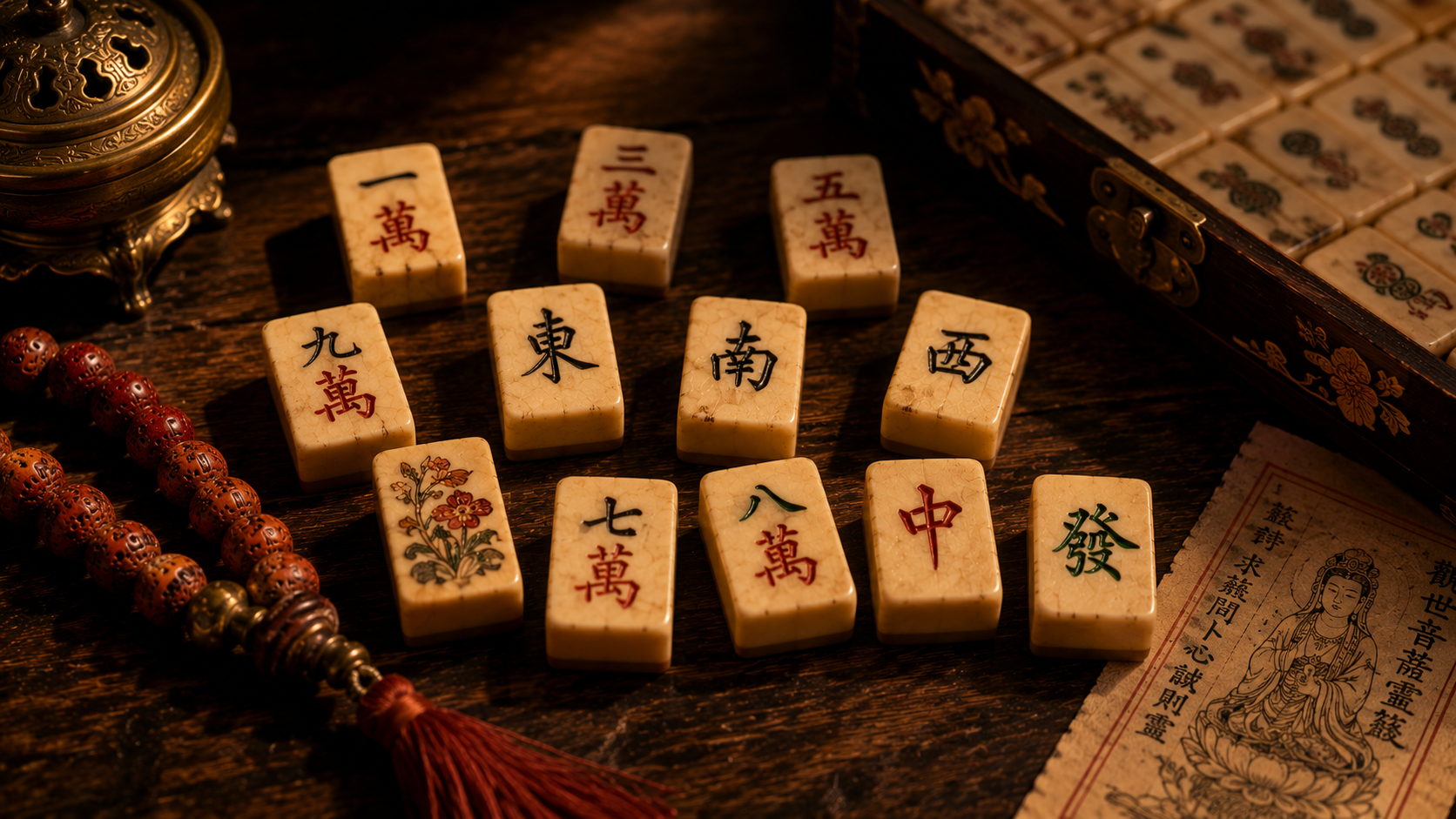
So she comes in for a reading and I tell her, pick the tile closest to you. Whatever tile. Don't move it, leave it where it was, just flip. Mahjong tiles. Same game your grandma plays, or somebody's grandma, and you've walked past a table of them going at it in a park somewhere. Also a divinatory tool, depending who's sitting at the table with you.
She flips. Three. I'm like, you get threes a lot in your life. She's like, yeah, three's actually my number. And then threes keep coming for the rest of the reading, three in the next position, three in the one after that, three again when I go looking at the family, and by the end of it the table is going wild, absolutely wild, on threes.
So. Your spirit guides, and that's a broad term I'm using. There's three ancestresses here who want to work with you. And this part says they've been trying to get to you, in your dreams. She's like, yes, actually, my sleep's been rough for months. And I said what I always say when a body thing turns up at that table. Months of bad sleep is a question for a doctor, so go ask one, and nothing on this table is going to answer it.
Don't ask for a door to be open, if you don't want it open, right? Her ancestors want to work with her, and they've got goods for her, there's going to be some harsh lessons, packed in with the goods, and it's coming from a long way back in the line, like, further back than she has names for.
So I asked her where her family's from. Mountains or ocean? She's like, dad's side is ocean, mom's side is mountain. Yeah. That's what I thought. So this was all the maternal line. Threes everywhere. Korean ancestresses on the mountain side. The mountain lines I've read for don't sugarcoat anything, so that was them being polite about it.
Then she tells me she's preparing to start a business. Been training for years. Doesn't feel ready. And I'm like, you're never ready, that's not how this works. Nobody gets to feel ready for something like this. And the thing she was calling a business? Same family of work Korean shamans do, with drums and chants and trance. She was just using different language for it, and I pointed her back at her own line, where it already lives.
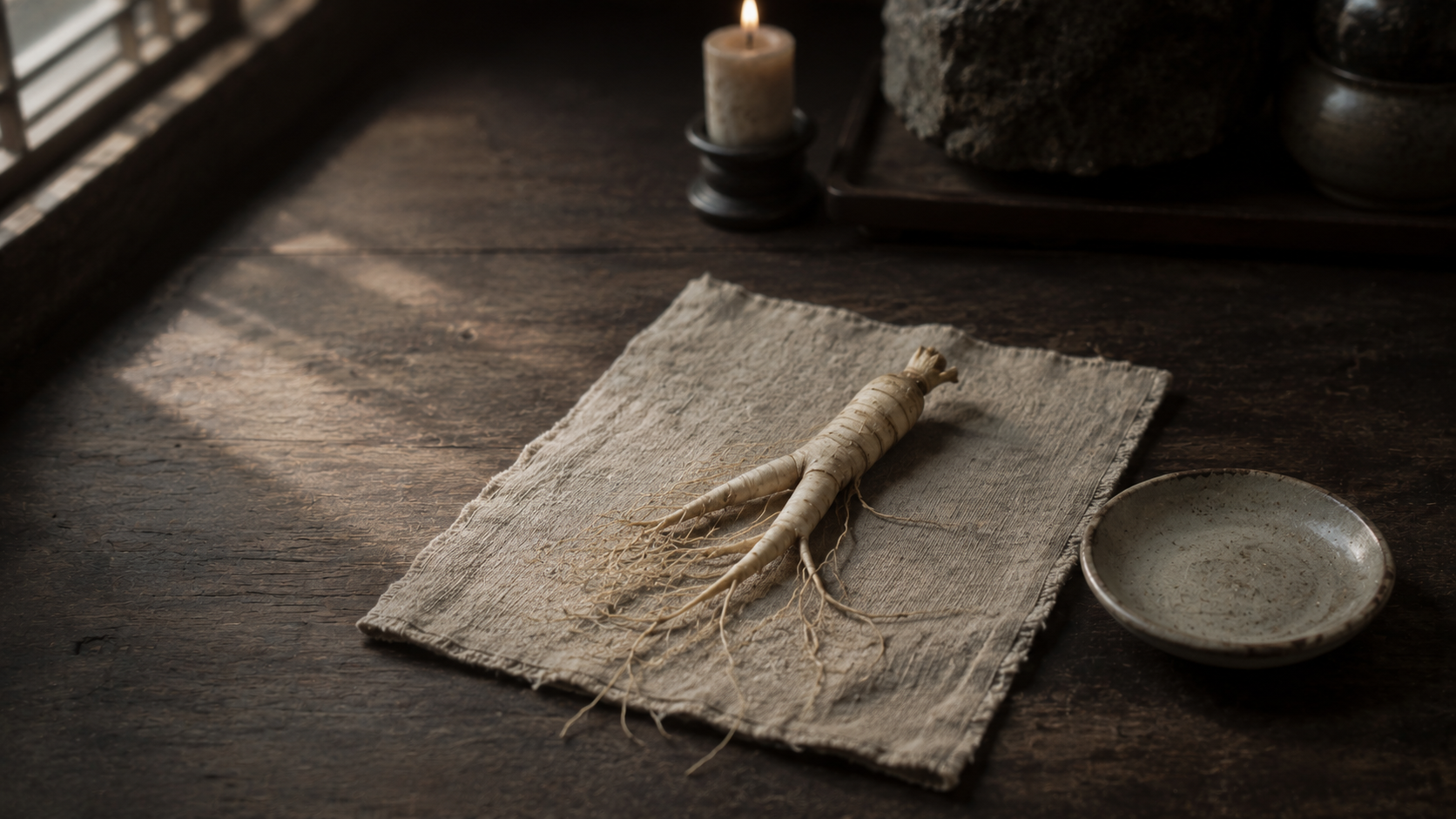
The tiles also turned up a talisman. Herbal magick. You connect to a plant and your energy moves over to match what it carries, and the talisman is the connection. Korean mountain ginseng, picked for her line. Nobody eats it. It sits on a surface. And it sits on the altar as an offering to that same line, so it's doing two jobs, right? My working logic, and not a named Korean tradition.
And she pushed back, which I liked. She's like, so is that a yes or a no on the business. I'm like, that's not a question the tiles answer, that's a question your grandmother answers. She didn't love that. She left with the reading and some homework, and I've got no idea what she did with either, because people don't come back to tell you.
And here's what I say to everybody who sits at that table. Whatever's going on in your body is your doctor's business, not mine. I don't diagnose there and I don't treat there. If something isn't settling, sleep or anything else, that goes to a doctor and a clinic, and the tiles don't replace that. Ever. What happens at that table isn't acupuncture and it isn't inside my licence, so I'd never bill it as healthcare. Different craft, different door.
So she'd swapped the frame. Drums and chants becomes a business, and the moves survive that, they always do. What doesn't survive is what the drum was asking of her. That's her business, right, and it's also this whole book.
The same thing happened to the medicine I'm licensed for, except there a government did the renaming. So this might be a kick to the face. I asked you up top, and if you're like most of the room you were picturing thousands of years. Here's the reality. What you'd learn in a Canadian acupuncture college, that's about 75 years old, writing this in 2026. It starts in 1950, at the First National Health Conference, where unifying Chinese and Western medicine goes in as state health policy. First four colleges open in 1956. Standardized textbooks land between 1958 and 1963. So the policy is three quarters of a century old, right, the schools are seventy, and the books your teachers taught out of, they're younger than the schools. About as old as some of your grandparents, right? When I teach the history segment in foundations I open class with exactly this, and I watch the faces go, and then I tell them, honestly, welcome to your 9:31am, sorry, I already broke all your dreams, first ten minutes of the first class of your program. Same energy for you.
And I'll flag the awkward bit myself, before you do. 1950 is where the state takes custody of the question, and what it decides that year is, honestly, closer to abolition than to promotion, and I'll show you in a minute. The turn comes in 1954. So if you want to date the version you were taught rather than the policy that produced it, you get seventy, right, not seventy-five. And I'd sooner hand you both numbers than pick the flattering one.
Ask most people, and they're picturing classical Chinese medicine. What you sit in a room and learn is traditional Chinese medicine. Big difference, right? And I have to start you here, because if I don't, it's just a whole lot of illusions, basically, ones you keep building on for the rest of the conversation.
And since I'm about to spend a book dating other people's things, I should date my own phrase too. Who made "classical Chinese medicine" a branded category, capital C, set against TCM? North America did, in the 1990s. Heiner Fruehauf institutionalized it, institutionalized it and popularized it, through the programme he built at what was then NCNM, through the 1999 essay I cite for you at the bottom, and he isn't a neutral party to any of it. Did he coin the phrase? He didn't, and I'm not going to say he did. The material it points at, that's old. The name is newer than the thing it accuses. Same way "acoustic guitar" only became a phrase once somebody plugged one in.
Real quick on the modern Canadian curriculum, because it's probably not what you picture. Two to three years for acupuncture. Herbs sit outside your scope, over in the separate TCM practitioner credential. Hundreds of hours of student clinic. And your qigong and tai chi, they sit in there as a course or two. In classical lineages, they're the daily cultivation practice. So which version did you get? And that gap costs you, because this work runs through your own body. Some days you finish heavy, depending what the person walked in carrying. The cultivation is the part that fills you back up, right? So take that out and keep everything else, and you're trying to run the car without ever putting gas in it.
So that's your official curriculum. And what else did I get? Individual teachers handed me things, things they carried themselves. Master Tung's points. Balance Method. Methods from the parallel Japanese and Korean acupuncture traditions. Medical qigong. Wu Yun Liu Qi (五運六氣), the five periods and six qi, the doctrine that reads the year off the Chinese calendar and tells you what that year is going to do to people. Bazi, the four birth pillars, which I use at the reading table and not in the treatment room. Family-line technique adjustments. And plenty more, depending who you end up learning from. And I said I'd date my own things too, so here they are. Master Tung is Dong Jingchang (董景昌), 1916 to 1975, and he took his first student outside the family in Taipei in 1962. Balance Method is Richard Tan's, Taiwanese-born, in the States from 1977, licensed in California in 1987, publishing the method from 1992 on. He died in 2015, right, which is the year I registered. So two of the things handed to me as old lineage are younger than the state curriculum they get taught beside, and one of the men who made them was alive when I qualified. So that whole list sits off the syllabus entirely, right? It was theirs to give, and they gave it to me, right, and I'd never tell you a programme delivered it. And a move comes with that, so watch me make it. You know Avatar, the cartoon? Kid gets in trouble, eyes light up, and every Avatar who ever lived is standing behind him. That's what I just did to you. I am the Avatar. Here are my teachers, and here are the teachers behind my teachers, and all of us are handing you this. It's a joke, right? It's also an authority move, and it's the same one an emperor makes when he starts listing ancestors. So I'd sooner you caught me at it than felt it land.
So that's TCM, right? Is it enough to build a practice on? It is. It's what the profession is regulated on, examined on and insured for, right, and it's what I was licensed in. Whether any given treatment helps any given person is an empirical question, and it isn't the one this book answers. It's also a specific historical version of Chinese medicine, the post-war reform version, right? And that history, it matters for what comes next.
The Secret Menu Index. One page. Everything the standardized curriculum dropped, renamed, or de-framed, and where each piece went. Free, by email. Get it here.
And the political history, it's more layered than the diaspora version you've probably been handed. So let me walk you through it. The Abolition of Old Medicine proposal, drafted by Yu Yunxiu, was carried by the first Central Board of Health conference on 25 February 1929, the one the Ministry of Health convened, and it was carried in amended form, as principles for registering old-style physicians (《規定舊醫登記案原則》), basically, a resolution that merged four separate proposals aimed at old medicine. It never became law. There was a real organized fight. Practitioners went out into the street, and on 17 March 1929 a national delegates' congress convened in Shanghai, which is the date, still, the date the profession keeps as National Medicine Day (國醫節). The proposal got shelved before it ever became national policy, right? The medicine survived. Barely.
Years later, the communists won the civil war, and at first they did something closer to Yu's programme than to its opposite. The First National Health Conference in 1950 set the policy of uniting Chinese and Western medicine, and in the same breath it set up improvement schools (中醫進修學校), to retrain Chinese-medicine doctors in Western medicine. Seventeen of those schools by the end of 1951, and a hundred and one improvement classes under various names alongside them. Union on those terms means one side doing the learning. It's the same way a merger works when one company keeps the name and the other one keeps nothing, right? The full-throated promotion comes later, after Mao's criticism of the Health Ministry in 1954, and the removal of its leadership in 1955. Kim Taylor lays that sequence out and I'm following her on it. Mao didn't speak at that conference. His contribution was a written inscription calling for the unity. The line everybody quotes at you is a different one, and I'll be straight that the year on it is unsettled. Taylor prints it, Slate dates it to 1950, and the PRC's own compilations put this wording in 1953 and 1954. Nothing I'm arguing turns on which. Here it is. "Our nation's health work teams are large. They have to concern themselves with over 500 million people [including the] young, old, and ill. ... At present, doctors of Western medicine are few, and thus the broad masses of the people, and in particular the peasants, rely on Chinese medicine to treat illness. Therefore, we must strive for the complete unification of Chinese medicine." That's Kim Taylor's translation. Five hundred million people, right? So that's a logistics number, and not a love letter. He isn't praising the medicine, he's counting the doctors. Scaling Western medicine for 500 million people, that was never going to happen, honestly, not on post-civil-war resources. And promoting TCM worked as anti-imperialist signaling on top of that, indigenous Chinese knowledge standing up against Western medical dominance. It wasn't an ideological commitment to the tradition.
And what's more screwed up? Mao himself didn't believe in it. His personal physician, Li Zhisui, recounts him saying so directly in The Private Life of Chairman Mao. "Even though I believe we should promote Chinese medicine, I personally do not believe in it. I don't take Chinese medicine." That quote is challenged on its sourcing, and I've put the challenge in the reading list for you.
Then the Cultural Revolution kicked off in 1966, and you got the Four Olds campaign. Old Customs, Old Culture, Old Habits, Old Ideas. And a lot of Chinese medicine got swept into it. It's in Miriam Gross's 2018 paper in Medical History, and the next three sentences are hers. Ancient medical tomes burned. Family grave sites and lineage halls destroyed, right? And an extraordinary number of the elite elderly doctors, who were the actual repositories of the tradition, persecuted and tortured and in some cases killed outright. Gross went through a commemorative collection of biographies, forty-six elite physicians in Jilin Province, basically, physicians who were alive during the Cultural Revolution, and she found that 63% of them recorded experiences from it, experiences that led to retirement, or to devastating illness, or to death. Nationally, the number of Chinese medicine doctors went from 361,000 in 1959, down to 240,000 by 1977. Now the objection, and it's the first one anybody raises. Wasn't the same decade expanding Chinese medicine? It was. Gross's own paper gives you roughly 1.08 million barefoot doctors between 1969 and mid-1974, a national herbal campaign, and an acupuncture revival that turned up large numbers of new points. So the decade didn't simply destroy this medicine. It destroyed the elite, lineage-transmitted, text-based end of it while mass-producing a thin standardised version at village level, and the number I just quoted counts the first kind of practitioner and not everybody holding a needle. So sit with what that means. The medicine the state was officially promoting, it was getting its infrastructure dismantled at the same time, and I mean the people and the books and the family trees that connected the two of them, all three going at once. And think of it as a trade where the manual was never really written down, because the manual was a person. You can lose a lot of copies of a book. You cannot photocopy a grandmother.
After it wound down in the late 70s, the lineages that survived had to rebuild out of whatever pieces were still lying around. And this next bit is lineage talk, not history. My teachers say a lot of what got pulled back together came from outside the mainland, and Korea is the name I keep hearing, usually with the Dongui Bogam attached. Edges hold old things, right? Same way the oldest French anybody speaks is in Quebec, and not in Paris. And the Dongui Bogam does preserve Chinese material China later lost, so that half is documented. The other half, whether China went and retrieved it afterward, is in the reading list, and the reading list argues against me.
So what survived in the standardized curriculum? Most of the methods, reframed without their spiritual context. Familiar enough that people recognize it as some kind of medicine, and exotic enough that it still gets filed under alternative. Kind of like a war dance that gets booked as a cultural performance, right? Every step is still in it, right? Nobody's going to war afterward, and the man doing it doesn't have to be ready to.
Come back to 1929. Yu Yunxiu was not a fool, and he was not a foreign agent, right? He was a Chinese physician, Japanese-trained, and he had read the classics closely enough to write a book, attacking them line by line. He looked at yin-yang, at the five phases, at the channels. And he said, this is a cosmology, it's groundless, and as long as people think this way, the country cannot have modern public health. So abolish the whole thing.
Here's the sentence everything turns on. 舊醫一日不除,民眾思想一日不變,新醫事業一日不向上,衛生行政一日不能進展. So long as old medicine is not abolished, the thinking of the people will not change, the enterprise of new medicine will not advance, and health administration cannot progress. And the measures underneath it were not gentle. One-off registration and no more after that. Retraining. Time-limited licences for the older practitioners. No advertising. Close the schools. So he went after the trade as well, and I'm not going to pretend he didn't. Think of it as going after the licence and the language in one motion, right, and only one of those two was the point. But look at what he put at the top of the demand. Not the needle, not the decoction, not the pulse or any of the rest of the trade. The thinking. He'll concede clinical results in places, and he does. What he wants gone is the way of thinking, and he says so in the sentence he chose to hand the measures off with.
Now take me, ninety-seven years later, looking at the same yin-yang and the same five phases and the same channels you were taught. This is a cosmology, right? It runs on correspondence and resonance and worked timing and a conditioned operator, right? And there's a word for systems, systems built that way.
So he and I agree on the description. We disagree completely on the verdict, and that's the whole thing, that's what the rest of this is about. So let me be unfriendly about it for you, because the profession has spent a century getting this backwards. A colleague tells me calling this magick insults Chinese medicine. Listen to what's being conceded there. Am I being told the description is wrong? I'm not. I'm being told magick is contemptible, and the medicine should be kept away from it. Which is Yu's premise, adopted whole, by the people who beat him.
So think about how that fight actually got won. Did they dispute his account of the reasoning? They didn't. They promised to become something else. They built a curriculum, one that could pass for physiology, they translated 邪 as "pathogenic factor," they filed the ghosts off the ghost points, and then they presented you the remainder, basically, as the real thing that had been there all along. The profession survived 1929 by conceding the shameful part and hiding it, right? And that reading isn't original to me, it's substantially Sean Hsiang-lin Lei's argument in Neither Donkey nor Horse. The unfriendly way I've put it, that's mine.
And it worked. Right. I have a licence, because it worked. And would you have done any different? So I'm not sneering at people who did what survival required, honestly, in a century that included Yu Yunxiu, the Cultural Revolution, and, in my own province in 2022, Schedule 5 of Bill 88, the Traditional Chinese Medicine Repeal Act, which would have repealed the Act that made our college, and handed the college, you know, to an administrator to wind it up. The Ministry said oversight would move to the Health and Supportive Care Providers Oversight Authority, with registration voluntary. Which wasn't a merger, and that's the part people get wrong. It was deregulation. And then the profession organised, and on 10 March 2022 the government voted its own schedule down in committee. Same move as 17 March 1929, right, ninety-three years later. But you don't win an argument like that once. You win it on instalments. And one comes due every time a patient asks you what qi actually is and you hear yourself answering out of Yu's dictionary. Bioelectric something. Fascia, maybe. True enough, and not the reason you put the needle where you put it. So do I keep making the payment? I don't. I think it's the most interesting thing about the medicine, and I'd sooner name the system than keep winning the argument by pretending it's a different one.
And that's the fight I've been circling this whole chapter, so next I'll stop circling. I'll tell you exactly what I mean by the word, in nine parts, and then I'll count how many of them are already sitting in your clinic.
Next: Your Clinic Runs Eight of Nine. Subscribe and you'll get it when it drops.
The Secret Menu. The paid tier of this book, and later the classes. The free side argues that this medicine is magick. The paid side is where I stop arguing about it and start teaching the spiritual practice on its own terms. Ritual, cultivation and correspondence work. Strickmann reconstructed what the operators did from the texts. This goes the other direction, from somebody doing it. It's open, $45 a month, Canadian. That's the founding rate, and it closes when the first class ships. It goes up for people who come after that, and it never goes up for you while you stay in. Cancel and it's gone, and you'd come back at whatever the price is then. So the rate is for members, not for names on a list.
What it is and isn't. It teaches ritual, cultivation and correspondence practice as spiritual and educational work. It is not a clinical course, it does not teach acupuncture or TCM diagnosis, nothing in it is offered as treating, diagnosing or curing any condition in you or anyone else, nothing in it is presented as making any regulated treatment more effective, and finishing it confers no competency to treat. It is not open to my acupuncture patients, and subscribing creates no practitioner-patient relationship of any kind.
This is a personal essay on the history and philosophy of Chinese medicine and my own practice, not medical advice. Every person described in this book is a composite drawn from several sources, with identifying details altered or invented, and no scene is a record of an actual patient or session. When I argue that this medicine is a magical system, that's a claim about how a historical system of reasoning works, not a claim that any treatment produces any effect.
Who I am, what the credentials are and aren't, how I handle the Chinese, and the full scope note. About This Book. It's one page, and it dates my own lineage, the same way this chapter dates everybody else's.
I'm not a historian, and I'm not a translator. The classical readings here lean on the scholarly translations below, and practitioners from other streams will read some of these passages differently.
Zachary Lui, R.Ac. Registered Acupuncturist, College of Traditional Chinese Medicine Practitioners and Acupuncturists of Ontario. The reading, ritual, correspondence and teaching work described on this page is not provided under that registration and is not health care.
The apparatus for this chapter. The categories, the anthropology, the character work and the dating of the nine operations travel with chapter two, where they're argued.
On what a curriculum transmits versus what a lineage does. This is the one I'd hand you first. Elisabeth Hsu, The Transmission of Chinese Medicine (Cambridge University Press, 1999), is fieldwork on three modes of transmission, inside one Chinese city, the standardized college, personal transmission from a senior doctor, and secret transmission, including cultivation practice. So that's your difference between a syllabus and a lineage, documented by somebody with no stake at all in my argument.
The Dongui Bogam. Compiled 1610, published 1613, and it does preserve passages from earlier Chinese texts, ones later lost in China. That preservation happened at compilation, and the book circulated in Chinese printings continuously afterwards, so it's evidence of Korean transmission holding material China lost, and not of a text China went and retrieved after the Cultural Revolution. Academic accounts of the post-1976 reconstruction emphasize domestic recovery more than the diaspora-lineage version does. Korea is the only leg of this I can support; there is no evidence I can find for a Japanese Kampo or Vietnamese contribution to the reconstruction, and I make no claim about either.
On Bill 88. Read the bill as introduced on 28 February 2022, and not the one that passed, because they're different documents and this is the one place a reader can catch me looking wrong when I'm not. Bill 88, first reading carries Schedule 5, the Traditional Chinese Medicine Repeal Act, 2022, and its own explanatory note says the College "is continued as a corporation under the control of an Administrator, who is tasked with its winding up." The Oversight Authority and the voluntary registration aren't in the schedule text; that's the Ministry of Health's stated destination, on the record through the Canadian Press on 2 March 2022. At clause-by-clause in the Standing Committee on Social Policy on 9 March the government gave notice it would vote against its own schedule, and the College's announcement of 14 March, "Bill 88 Amended to Remove TCM Repeal Act, 2022", dates the removal to 10 March. So the Working for Workers Act, 2022, S.O. 2022 c. 7, got Royal Assent on 11 April 2022 with four schedules and no fifth. The profession beat it, the same way it beat Yu Yunxiu, and I'd rather you knew that than took my sentence for it.
On the twentieth-century history. This is where you check the numbers I gave you. Miriam Gross's 2018 paper in Medical History, "Between Party, People, and Profession: The Many Faces of the 'Doctor' during the Cultural Revolution", is where the Jilin stats and the national physician decline come from, and the 63% is one province's elite physicians, and not a national rate, so please don't quote it at anybody as a national rate. Kim Taylor's Chinese Medicine in Early Communist China, 1945-1963: A Medicine of Revolution (RoutledgeCurzon) is the canonical text, on the post-1949 political construction of TCM. On the 1929 date: the committee sat 23 to 26 February and accounts date the resolution variously to the 24th, 25th and 26th. I print the 25th. For 1929, Sean Hsiang-lin Lei's Neither Donkey nor Horse: Medicine in the Struggle over China's Modernity (University of Chicago Press, 2014), that book handles the abolition proposal and its language properly, and it's where the argument I've borrowed, the one about how the profession survived by remaking itself, actually lives. Ralph Croizier's Traditional Medicine in Modern China (Harvard, 1968), that's the older treatment, and still worth your time. Volker Scheid's Chinese Medicine in Contemporary China: Plurality and Synthesis covers mainland practice now, and how plural it is, and his framing leans more on synthesis than mine. Bridie Andrews has The Making of Modern Chinese Medicine, 1850-1960 for the broader pre-1949 history. For the Classical versus Traditional distinction, Heiner Fruehauf's 1999 piece "Chinese Medicine in Crisis: Science, Politics, and the Making of TCM" in Journal of Chinese Medicine, that's the foundational essay.
On the 500 million quotation. It's Kim Taylor's translation, in Chinese Medicine in Early Communist China, 1945-1963, chapter two, and it reaches most English readers through Alan Levinovitz's Slate piece, which dates it to 1950. I'll be straight with you about that date. I can't corroborate a 1950 Chinese original. The PRC's own compilations of Mao's directives on Chinese medicine carry a September 1949 statement to the delegates of the national health administration conference, 「只有很好地團結中醫,提高中醫,搞好中醫工作,才能擔負起幾億人口艱鉅的衛生工作任務」, only by uniting Chinese medicine well, raising it up and doing the work of it properly can we shoulder the arduous health task of several hundred million people, which is the same argument in the same shape. And they place the 五億-plus-西醫少-plus-農民靠中醫治病 wording in 1953 and 1954. So take the quotation as Taylor's and the year as unsettled. Nothing I'm arguing turns on which year it is. The improvement-school figures, 17 schools and 101 classes by the end of 1951, are from the Chinese Association of Chinese Medicine's own account of the period.
On Mao's private views. Li Zhisui's The Private Life of Chairman Mao (Random House, 1994) is the source for the "I personally do not believe in it" quote. Is it contested? Yes. Some Mao biographers challenge it on sourcing, since it's a physician's memoir of a private conversation. It's also the most-cited English-language source on his private views, so you're going to meet it either way. Want the short read? Alan Levinovitz's 2013 Slate piece "Chairman Mao Invented Traditional Chinese Medicine. But He Didn't Believe in It".